Nexsis BioHealth has started collecting blood for lab work without a needle. No vein draw, no finger prick, a few minutes in the chair. We sat down with founder Juan Salcedo to ask what the device actually does, whether the results hold up against a standard venous draw, and why he now thinks nobody should start a peptide or regenerative protocol without labs in hand.
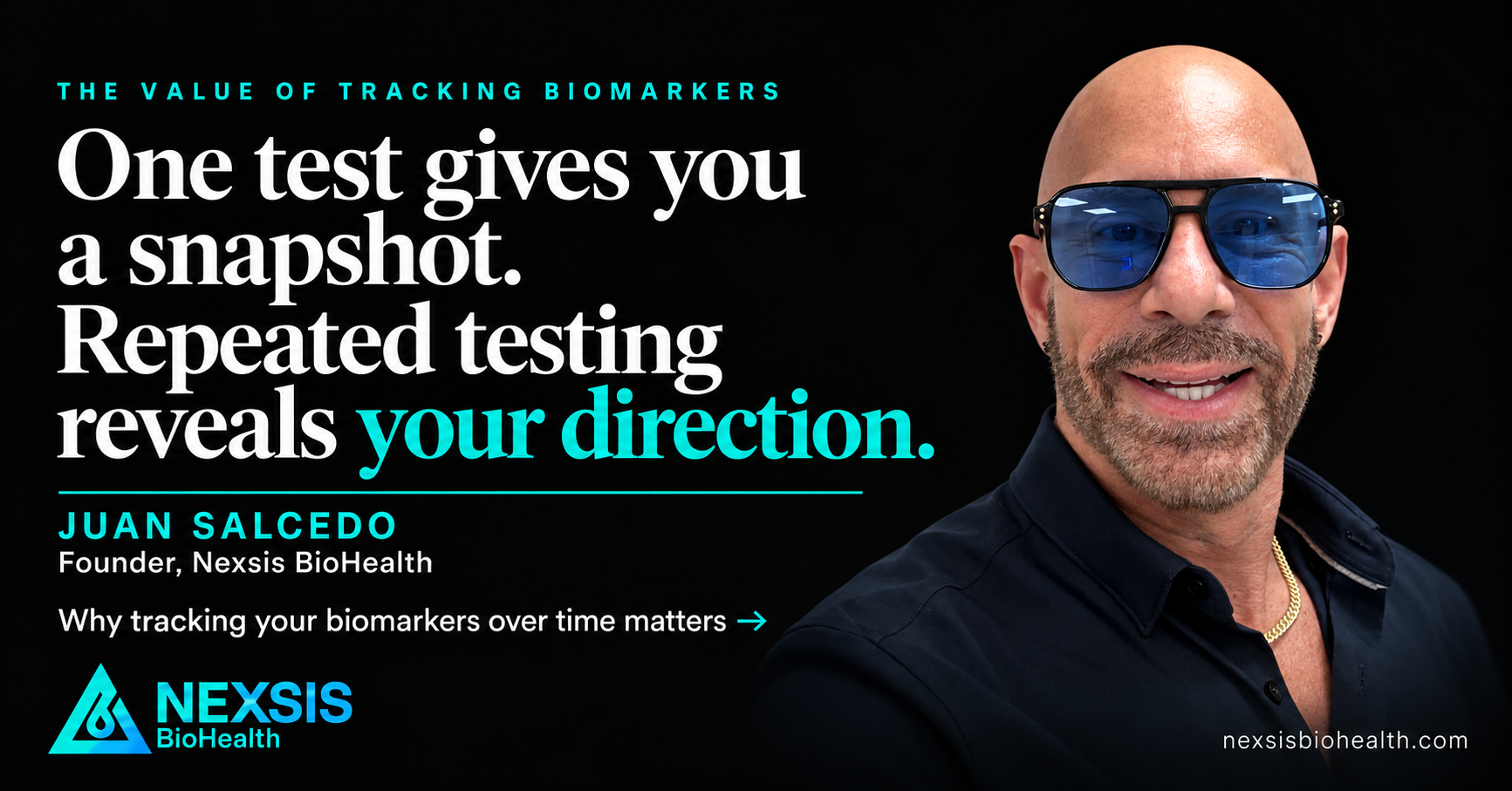
Juan Salcedo is the founder of Nexsis BioHealth in Brickell, Miami. Health Coach. Stem cell recipient. Heart health survivor. Stem cell and peptide therapy expert, biohacker and longevity advocate. Husband and father, on a mission to help others reclaim their health at the cellular level.
The interview below is lightly edited for length. Juan's words are his own.
Needle-free blood testing collects a blood sample through the skin instead of from a vein. At the Brickell clinic, a small single-use device warms a patch of the upper arm, then draws blood out drop by drop into a sealed collector. The sample goes to a laboratory for analysis. The patient gets a full biomarker panel back, with no vein draw and no finger prick.
Juan described it the way he describes it to patients.
It's by a company called [SiPhox], which lets us be able to draw blood for lab work without any pain, without any needles. It's done only in a few minutes and it has really changed the way lab works are being done really in the market.
The beauty of it is it doesn't have any needle. It just does through the skin. It's a through the skin process.
The clinic calls the service The Curated Draw. The collection unit is SiPhox Health's EasyDraw kit.
Two steps: heat, then gentle suction. Warming the skin brings blood toward the surface in that spot. The collector then draws it out through the skin a drop at a time. Nothing punctures a vein, and there is no tourniquet. Juan compares the first half of it to a warm towel.
You have to warm up the area and then once it warms up, blood concentrates in that area without any pain at all. It's just basically just like putting a warm towel in your arm. And then once you put this little device, it just basically just sucks drop by drop the blood out without any needles.

Collection is from the upper arm and takes a few minutes. Larger panels use more than one collector in the same visit, which is how the clinic covers panels running to forty markers and beyond without going near a vein.
No, and this is worth being exact about. Collection happens at Nexsis BioHealth in Brickell. Analysis happens at an outside laboratory. What changed is where and how the sample is taken, not who runs the assays. Juan says so himself.
It draws out all the blood that needs to be drawn to be able to send to a lab.
Samples are picked up the same day, which is the part that makes the timeline work.
Once a lab has blood, it does not matter much how that blood left the arm. The panel, the assays and the reference ranges are the same ones a standard venous draw would produce. The collection method is the variable. The analysis is not.
It's exactly the same because in the end, once you have access to the blood, then the testing process is very similar. The only difference here is how you collect it.
The collection method is the only thing that's different. The overall results, which is getting a list of all your biomarkers, that result is exactly the same.
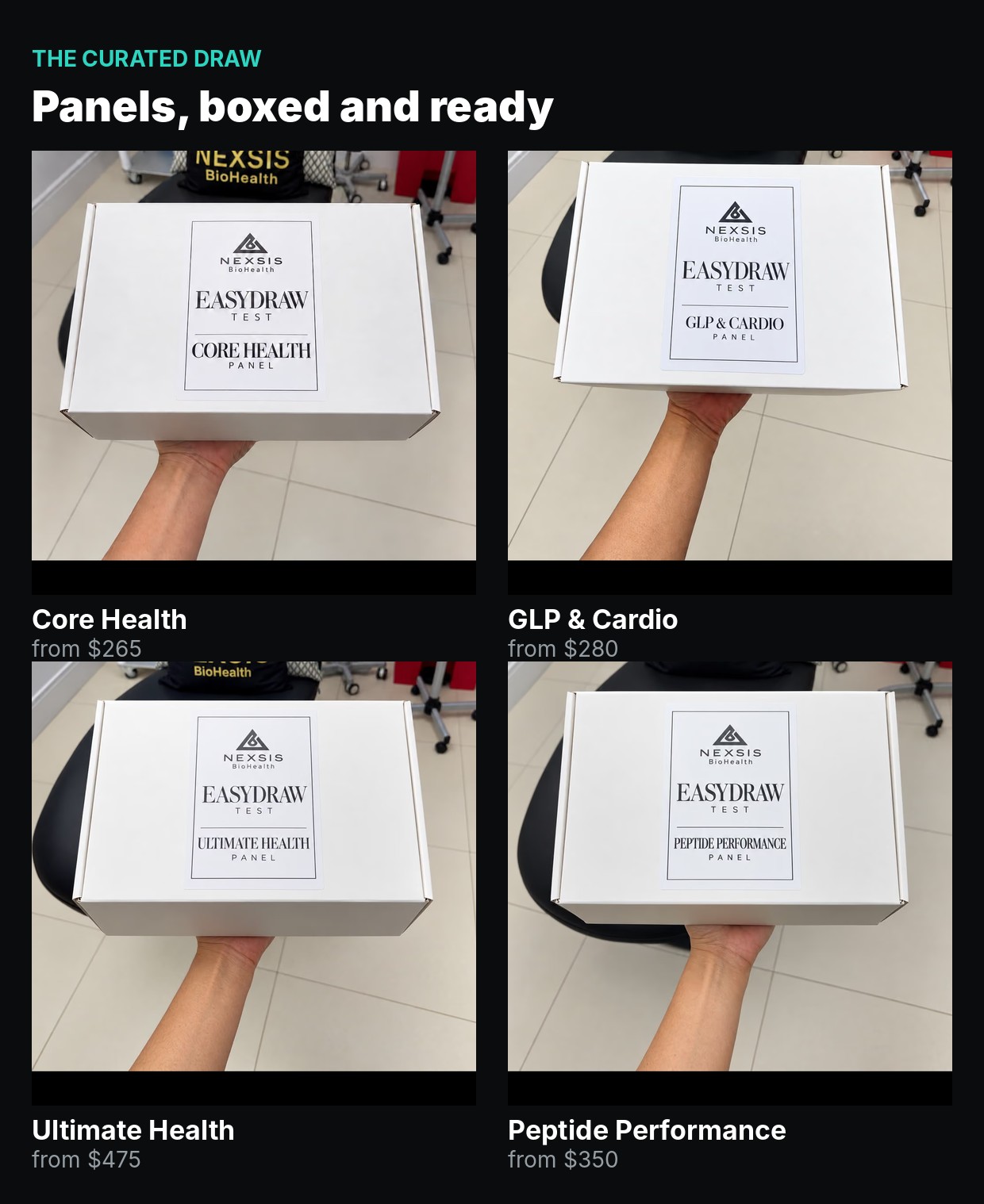
Each panel is built around a goal rather than a generic checklist. Six of them, from a yearly baseline up to the widest view the clinic offers. Descriptions here are at category level. For the specific markers in any panel, ask the team before you book and they will walk you through it.

Around sixteen to eighteen markers in a single collection. Cholesterol and the wider lipid picture, blood sugar control, inflammation, vitamin D, iron storage, thyroid, and the core sex hormones. This is the yearly baseline and the right first test for anyone who has not had bloodwork in a while.
Twenty-five markers in a single collection. The full lipid and cardiovascular picture, blood sugar and insulin signaling, inflammation, and liver and kidney function. Built for people on semaglutide, tirzepatide or another GLP-1, and for anyone watching metabolic and heart markers while their weight and habits change.
Sixteen markers across two collections. A full blood count alongside the hormone markers that matter while you are on hormone therapy, with a prostate marker added for men and progesterone for women. Built for regular check-ins rather than a one-off.
Fifteen markers across two collections. The female hormone picture, thyroid including the active thyroid hormone, iron status and blood sugar. For women tracking a change they have noticed or building a baseline for the years ahead.
Twenty-five markers across two collections. Full blood count, liver and kidney function, inflammation, blood sugar, the relevant hormones and a growth-factor marker. Baseline and follow-up for anyone on a peptide protocol or about to start one.
Forty-one markers across three collections, and the widest view the clinic offers. Advanced lipid and cardiovascular risk markers, metabolic and inflammation markers, the stress hormone, vitamins and minerals, full iron studies, liver and kidney function, full thyroid including antibodies, and the complete hormone set. A deep baseline, or a longevity check-in you repeat.
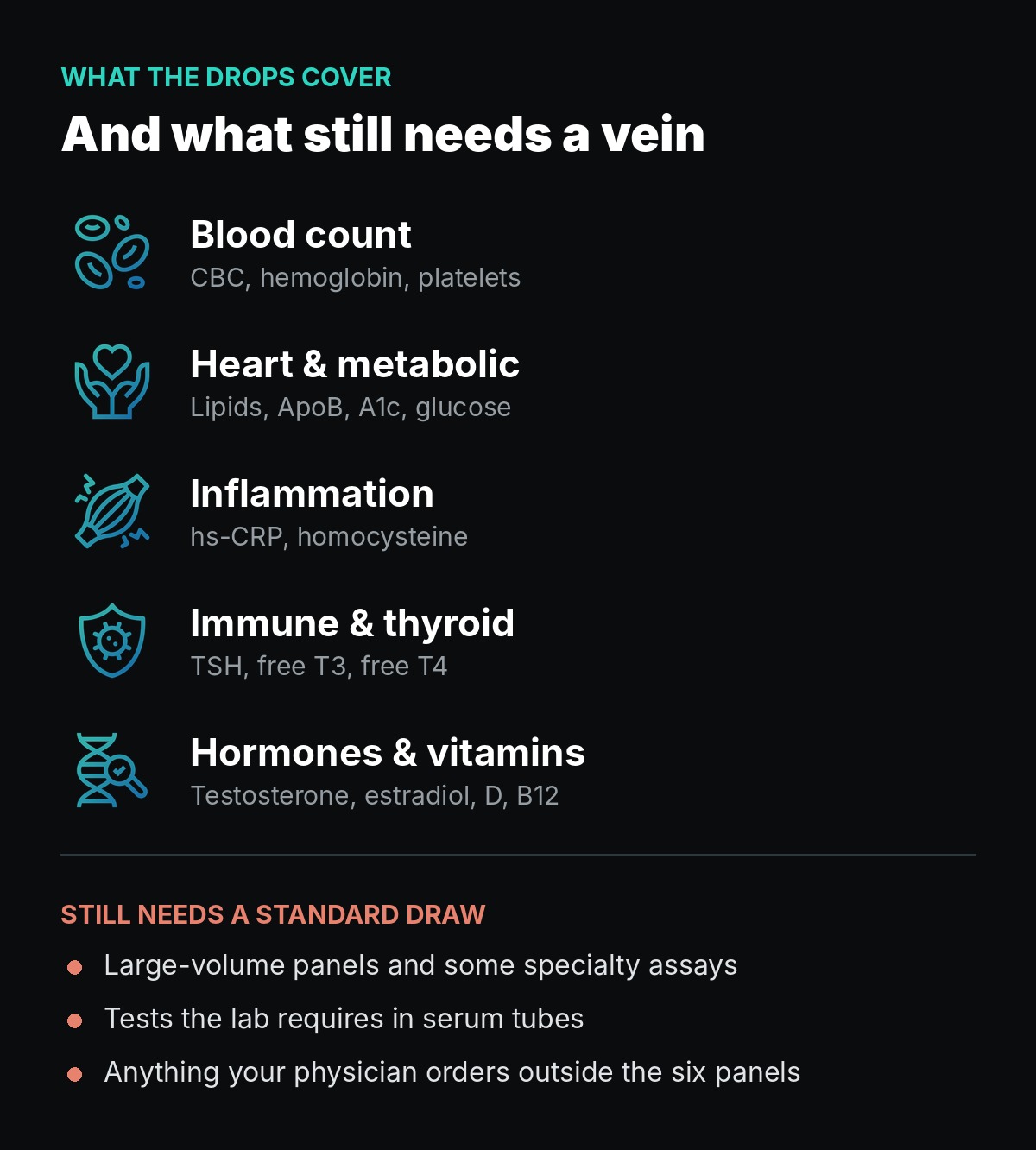
One category, and Juan volunteered it without being pushed. Heavy metals still need a conventional draw. If that is what a patient needs tested, the clinic sends them for a standard venous collection instead.
I would say if we would be looking at what would be the one type of biomarkers that we would not be able to do with these tests, which specifically has to be with heavy metals.
Being able to name the limit is a reasonable test of whether a clinic understands what it has bought.
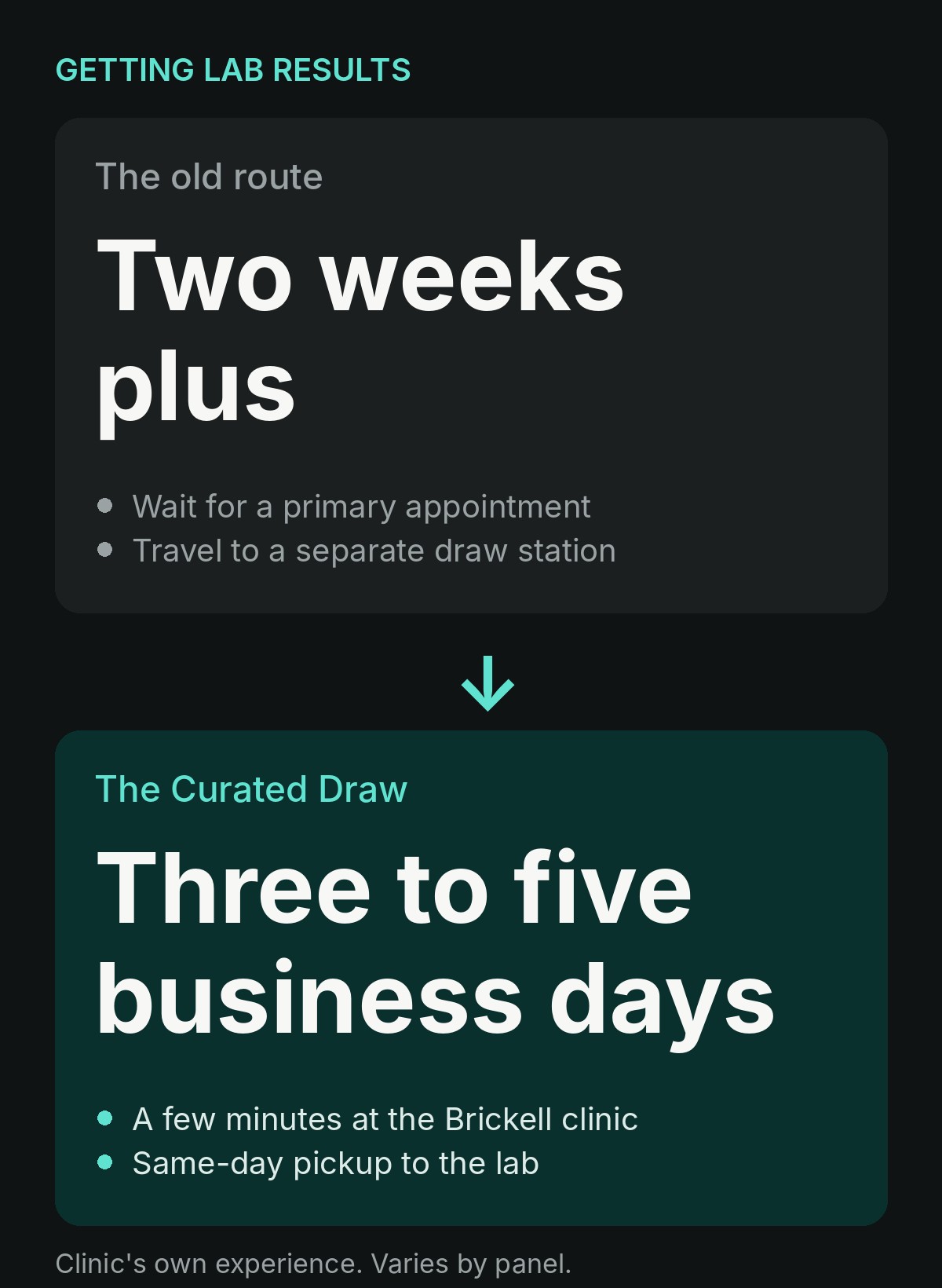
Juan puts it at three to five business days in the clinic's own experience, which is roughly what a conventional lab order takes once it is actually in motion.
It takes about the same amount of time. I would say anywhere between three to five business days we get the results back.
Timing varies by panel. The team tells you what to expect at your visit.
The delay was almost never the lab. It was the referral chain in front of it: get an appointment with a primary care doctor, get the order written, go somewhere else to be drawn, wait for results to come back through that same doctor.
That process could take anywhere between one to four weeks depending on how quickly their primary would take care of them.
So that process was taken, like I said, at best case was a week, but it was really never really taken a week. It was two weeks plus.
For a patient starting a protocol, two weeks of waiting is two weeks of either sitting still or starting blind. Neither is a good option.
Because most people have no idea it exists. Juan's answer here was the least promotional thing he said all call, and it is the part worth paying attention to.
People are not asking for it because a lot of people just don't even know that it exists. They just assume that every time that they're going to give blood or they have to have blood work, they have to go through the painful process of the needles.
And that assumption has a cost.
Because of the fact that they are fearful of it, a lot of times, they delay their blood work because of that fear.
Needle fear is not a small or rare thing, and the clinical consequence of it is not the fear itself. It is the lab work that never gets done.
Juan's answer was about veins rather than conditions.
So I think it's best for the very old and the very young.
His reasoning for older patients was specific:
They don't have as much muscularity. They don't have visible veins. Sometimes you have to poke them many times in order to be able to access the vein.
Anyone who has watched a parent get stuck four times for one panel knows exactly what he is describing. The same logic covers children, patients with small or difficult veins, and anyone with a history of fainting during draws.
This is where the conversation stopped being about a device. Juan's position is that a protocol built without labs is a protocol built on assumptions, and some of those assumptions carry risk. He gave a concrete example involving growth hormone peptides and blood sugar.
There's particular peptides that push your sugar levels up. So if you're pre-diabetic, and you don't know that, and then you're taking a peptide that's going to increase your human growth hormone, now you're potentially going to take a peptide that's going to push your sugar levels even higher, which can cause a whole bunch of other problems, inflammation.
Blood sugar markers would catch that before the first dose. Without them, nobody in the room knows. This applies the same way to peptide therapy, stem cell therapy and medical weight loss, which is why lab work sits in front of all three at Nexsis BioHealth rather than beside them.
Every three to six months, in Juan's view, and the reason is trend lines rather than single readings. One panel tells you where you are. Four panels tell you which direction you are moving in.
I think everybody should be doing blood work more often because there's a lot of changes that happen. You know, some people can wait three, five years between blood work and there's a lot of things that can happen in those five years.
They should do it every three to six months to be able to maintain. We can create trend lines to see exactly how you're trending.

He was careful not to turn that into a single rule for everyone.
It's going to be very individualized.
That cadence is also why the clinic runs standalone blood testing memberships rather than treating each panel as a one-off.
One-time pricing runs from $265 for Core Health to $475 for Ultimate Health, with GLP & Cardio at $280, HRT Monitoring at $285, Women's Health at $300 and Peptide Performance at $350.
If you plan to track rather than test once, two standalone memberships bring the price per test down. The monthly membership is one test every month, from $190 to $345 per test depending on the panel, with a six-month minimum. The quarterly membership is one test every three months, from $220 to $390 per test, with a twelve-month minimum. You pick the panel you want to follow.
These blood testing memberships are separate from the Nexsis BioHealth Membership Reserve, which is the clinic's wider program of monthly credits and service discounts.
You do not need a membership and you do not need another service booked to get labs done. Blood work can be booked on its own, and new clients are welcome.
We asked for a closing thought and got the strongest statement of the call.
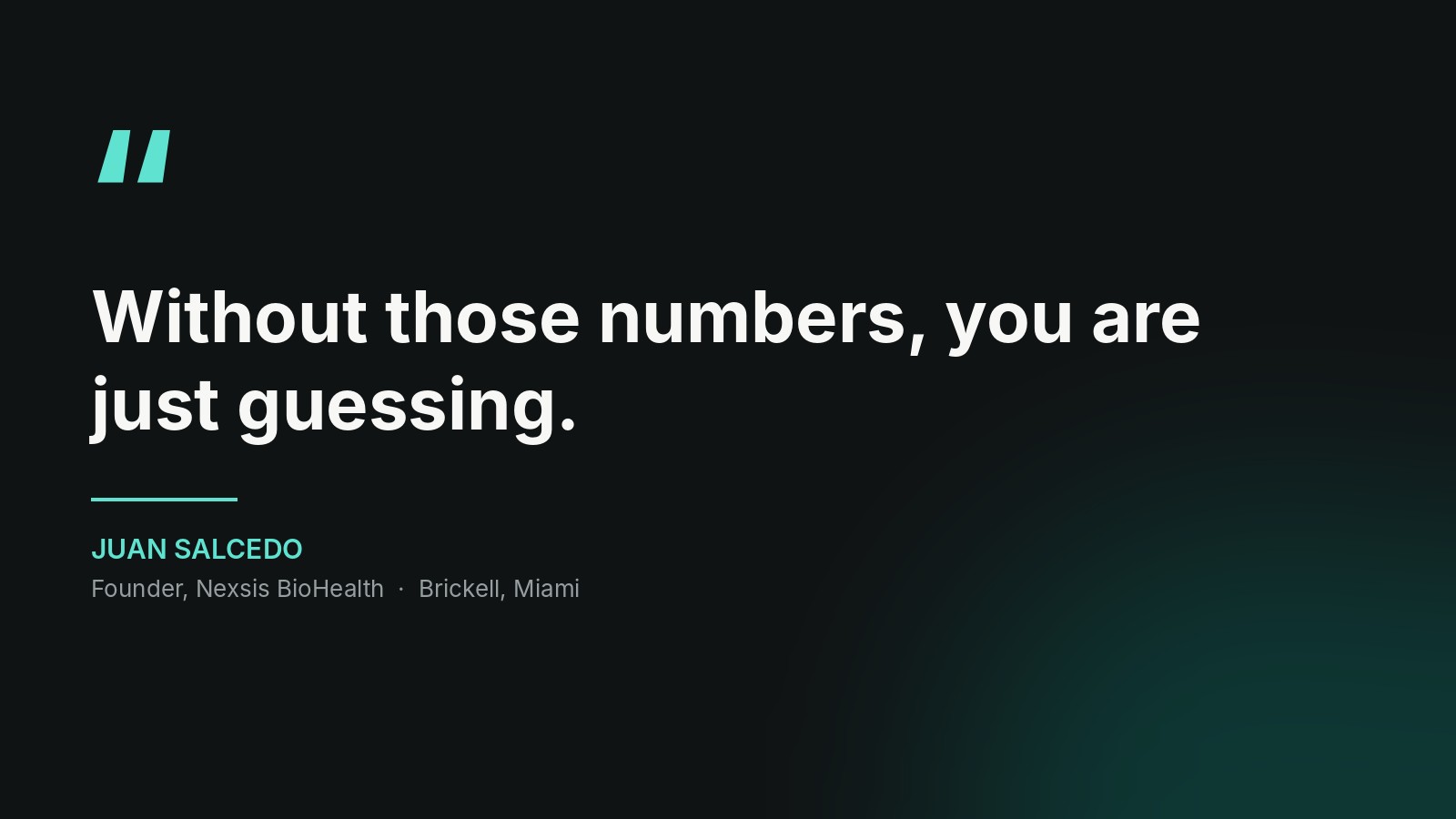
In order for you to have the optimum results from any type of regenerative medicine or biohacking or longevity type protocol or treatment, you have to know the person's overall condition and their labs. Without their labs and without those biomarkers, without those numbers, you are just guessing. And what we want to do is provide real results based on real data, not guessing.
Get your labs done. Don't do anything without getting your labs done.
For a clinic that sells regenerative treatment, that is a slightly inconvenient thing to say out loud. It also happens to be the right order of operations.
The Curated Draw is available now at Nexsis BioHealth, 40 SW 13th St, Suite 601-602, Brickell, Miami. Panels start at $265 and can be booked without a membership or any other service. We see patients from Brickell, Coral Gables, Coconut Grove, Downtown Miami and Key Biscayne.
Book blood work or a consultation with our physician team. If you want to understand what the results would change, read about peptide therapy, stem cell therapy and medical weight loss at our Brickell clinic.
Juan Salcedo is the founder of Nexsis BioHealth, a physician-led regenerative medicine clinic at 40 SW 13th St in Brickell, Miami. He is a Health Coach, a stem cell recipient and a heart health survivor, and works as a stem cell and peptide therapy expert, biohacker and longevity advocate. He is a husband and a father, on a mission to help others reclaim their health at the cellular level.
Juan is available for media interviews and expert commentary on regenerative medicine, blood biomarker testing, peptide therapy, stem cell therapy and longevity. Contact the clinic at Info@NexsisBioHealth.com or 844-741-1580.
This interview reflects Juan Salcedo's clinical experience and opinion as the founder of Nexsis BioHealth. It is not medical advice. Juan is a Health Coach, not a licensed physician, and all treatment decisions at Nexsis BioHealth are made by our licensed physician team following consultation and review of lab results. Blood biomarker results should be interpreted by a qualified clinician.